
Introduction
There’s a specific kind of business problem that only shows up once things start going well: too many leads arriving too fast, with no system built to handle them. It’s a good problem to have, until it isn’t.
One of our retail clients ran into exactly this. They sell CCTV cameras both wholesale and retail and also run a home automation division. After launching a mix of paid ads and organic marketing, they generated over 100 fresh leads in just a few weeks. Everyone was thrilled. Then the phone started ringing, and the cracks appeared almost immediately.
This case study breaks down what happened, why it happened, and how we solved it with a purpose-built WhatsApp chatbot without adding headcount, without expensive new software, and without disrupting the team’s existing workflow. If you’re evaluating WhatsApp chatbot development services or searching for how to automate WhatsApp leads, this is a real, practical look at what that process actually involves.
Client Background
To respect client confidentiality, we won’t disclose the business name or exact location. What we can share is the operational structure: a retail and wholesale business selling CCTV camera systems, with an additional home automation department offering smart home installations and related services.
The business had three distinct customer segments funneling through a single communication channel:
- CCTV wholesale buyers (bulk orders, distributors, resellers)
- CCTV retail customers (individual homeowners and small businesses)
- Home automation enquiries (smart home installation and consultation)
Each segment required a different sales conversation, different pricing logic, and critically, a different team member to handle it.
The Business Challenge
The marketing side of the business was working exactly as intended. A combination of paid advertising and organic social posts delivered more than 100 leads in a matter of weeks. On paper, this was a clear win.
In practice, every single one of those leads was landing on one WhatsApp number.
Three different employees were responsible for responding to enquiries one handling CCTV wholesale, one handling CCTV retail, and one managing home automation. But because all messages arrived in the same inbox, there was no way to tell, at a glance, which employee should respond to which message.
The result was predictable:
- Wrong team members responding to leads outside their expertise
- Delayed replies as messages sat unanswered while employees tried to sort out who should handle what
- Customers repeating themselves, explaining their enquiry multiple times to different people
- Mixed messaging and inconsistent information being shared
- A visible erosion of trust with potential customers who expected a quick, competent response
Why the Existing Lead Handling Process Failed
It’s worth pausing on why this happened, because the same failure pattern shows up in countless growing businesses.
Single Channel, Multiple Departments
Routing three different business lines through one WhatsApp number works fine at low volume. It breaks down almost immediately once lead volume increases, because there’s no built-in mechanism to sort incoming messages by intent.
No Lead Qualification Step
There was no process in place to ask a customer even one clarifying question before a human got involved. Every enquiry regardless of whether it was a bulk wholesale order or a single home automation consultation, entered the same undifferentiated queue.
Manual Sorting Doesn’t Scale
When three employees have to manually read every incoming message, decide whose responsibility it is, and then hand it off, delays are inevitable. At low lead volume, this might be a minor inconvenience. At 100+ leads in a few weeks, it becomes a full-blown operational bottleneck.
Before vs. After Automation
Before automation, all customer inquiries were received through a single WhatsApp number without any system for sorting or qualification. Employees had to manually determine which department should handle each inquiry, often leading to guesswork, delayed responses, and inconsistent routing. Customers frequently experienced repetitive conversations, as they had to explain their requirements multiple times, while internal teams struggled with overlapping responsibilities and unclear ownership.
After implementing WhatsApp automation, the same WhatsApp number intelligently qualifies each lead through an automated conversation. Based on the customer’s responses, the chatbot instantly identifies the appropriate department and routes the inquiry in real time. Customers only need to answer two simple questions before reaching the right team, creating a smoother and faster experience. At the same time, each department receives only relevant leads, resulting in clear ownership, improved workflow efficiency, and significantly faster response times.
Our Automation Strategy
We saw this operational mess for what it actually was: an opportunity to build a better system, not just patch the immediate problem. Our goal was to design a lightweight, low-friction WhatsApp business automation solution that solved the routing problem without adding complexity for the customer or the team.
We built the solution using Libromi, a WhatsApp automation platform, to create a simple but effective chatbot layer in front of the existing WhatsApp number.
WhatsApp Chatbot Planning
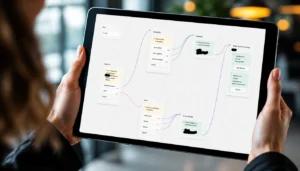
Before writing a single automated response, we mapped out the actual decision tree a human employee would use to sort incoming leads. The goal was to replicate that same logic but instantly and without requiring the customer to wait for a person to become available.
We kept the design principle simple: ask only what’s necessary, and nothing more. Long qualifying forms or excessive back-and-forth would frustrate customers and defeat the purpose of using WhatsApp in the first place, since people expect quick, conversational interactions on this channel.
Lead Qualification Process
The chatbot was built to ask just two qualifying questions the moment a new conversation started. These questions were designed to immediately determine:
- What type of enquiry the customer had (CCTV or home automation)
- Whether the CCTV enquiry was for wholesale or retail purposes
This lightweight lead qualification bot logic meant customers weren’t filling out a long form; they were simply answering two quick, natural questions, the same way they might if a helpful staff member greeted them at the door.
Automatic Lead Routing
Once the chatbot identified the enquiry type, it automatically routed the conversation to the correct team member in real time:
- CCTV wholesale enquiries → routed to the wholesale specialist
- CCTV retail enquiries → routed to the retail specialist
- Home automation enquiries → routed to the home automation specialist
This lead routing system eliminated the guesswork entirely. Team members no longer needed to scan through a shared inbox trying to determine which messages belonged to them; they only saw the conversations relevant to their department, already pre-qualified and ready for a direct, informed response.
Team Workflow Improvements
The operational impact went beyond just routing accuracy. A few workflow changes followed naturally once the chatbot was in place:
- Clear ownership: Each employee knew exactly which conversations were theirs to handle, removing ambiguity and reducing internal back-and-forth.
- Faster first response: Because the right person received the enquiry immediately, replies went out faster without needing to redirect the customer to someone else first.
- Reduced repetition for customers: Customers no longer had to re-explain their enquiry to a second or third person after being passed along.
- Better internal accountability: With conversations pre-sorted by department, it became easier to track response times and follow-up quality per team member.
Business Benefits
The shift from a single chaotic inbox to an automated, pre-qualified routing system delivered a number of concrete operational benefits:
- Faster response times, since the right person engaged with each lead immediately rather than after manual sorting
- Reduced customer confusion, as each enquiry was handled by someone actually equipped to answer it
- More consistent messaging, since specialists were now responding within their own area of expertise rather than fielding unfamiliar questions
- Scalable lead handling, meaning the business could continue running ad campaigns and organic marketing without the same bottleneck resurfacing
- Improved team morale, as employees were no longer stuck untangling misdirected conversations
We’re intentionally not attaching specific revenue or conversion percentage claims to this case study. The measurable, honest outcome here is operational: faster replies, correct routing, and a system built to scale, the foundation that supports better sales outcomes over time.
Key Lessons Learned
A few lessons stood out from this project that apply well beyond CCTV or home automation businesses:
- Marketing success can expose operational gaps. A surge in leads is only valuable if the business is equipped to handle it efficiently.
- Multi-department businesses need routing logic, not just a single inbox. Any business with more than one distinct service line funneling through one channel is at risk of this same problem.
- Two good questions can replace hours of manual sorting. Lightweight qualification, done right, is often more effective than a lengthy intake form.
- Automation should reduce friction, not add it. The best automation feels invisible to the customer, a natural, quick conversation rather than a clunky bot interaction.
- Every operational problem is a system design opportunity. The lead confusion wasn’t a marketing failure; it was a missing system, and it was fixable.
Why WhatsApp Automation Is Essential for Growing Businesses
As businesses scale their marketing efforts, lead volume increases, but without the right infrastructure, that growth can create more problems than it solves. WhatsApp automation matters because:
- WhatsApp is already the preferred communication channel for many customers, making it a natural place to qualify and route leads
- Manual sorting doesn’t scale linearly with lead volume; it breaks down faster than most businesses expect
- Multi-department businesses need a way to direct enquiries to the right specialist without adding manual steps
- Faster, more accurate first responses directly improve customer experience and reduce lost opportunities
- A well-built WhatsApp Business API integration can support CRM Automation, Customer Support Automation, and broader Workflow Automation as the business continues to grow
For any business running paid ads, organic campaigns, or both, an unmanaged lead influx isn’t a luxury problem; it’s an operational risk. Automation is what turns lead volume into a manageable, scalable asset instead of a bottleneck.
Why Choose ecom100
At Ecom100, we don’t just build chatbots; we design lead management systems around how your business actually operates. Our approach to WhatsApp chatbot development services includes the following:
- Process-first design: We map your real internal workflow before building any automation, so the chatbot mirrors how your team actually works
- Lightweight, customer-friendly interactions: We avoid long forms and clunky bot flows that frustrate customers on a conversational channel like WhatsApp
- Real-time lead routing: Our systems are built to direct enquiries to the right person instantly, not after a manual review step
- Scalable architecture: As your lead volume grows, our automation systems are built to scale with it, without requiring a rebuild
- Integrated automation: Our WhatsApp Chatbot Development Services connect naturally with our broader Business Automation Services, CRM Automation Services, and Digital Marketing Services, so your lead generation and lead management work together as one system
If your business is generating leads faster than your team can handle them, that’s not a marketing problem; it’s a systems problem, and it’s one we solve regularly.
Ready to Fix Your Lead Handling Before It Becomes a Bottleneck?
If your business runs multiple departments, product lines, or service categories through a single WhatsApp number, you’re likely closer to this same breaking point than you think. Our team can map your current lead flow and show you exactly where automation would save time, reduce confusion, and improve your customer experience.
Contact us today to discuss a WhatsApp chatbot built around how your business actually works, not a generic bot template.